Rheological Dynamics of Active Myxococcus xanthus Populations during Development
We measured the rheology of M. xanthus fruiting bodies, and demonstrated the first activity-induced viscosity reduction in a viscoelastic material.
Abstract
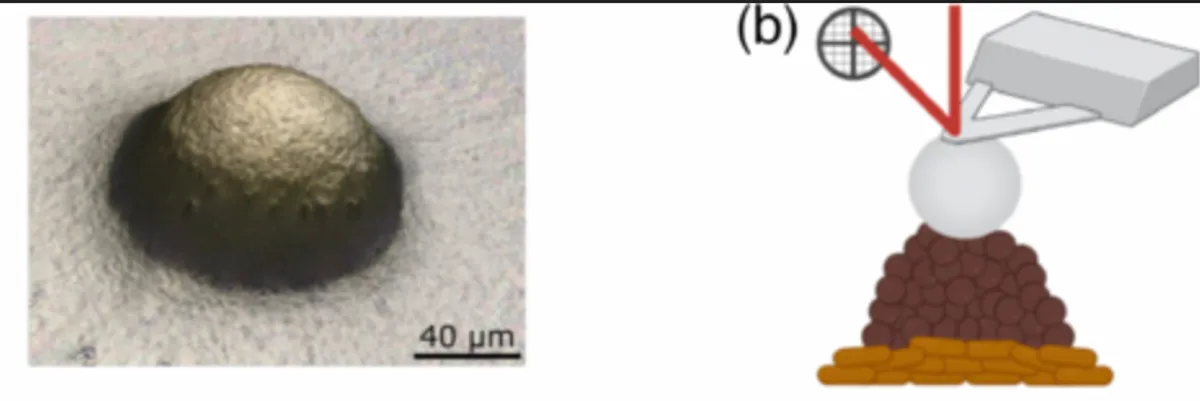
The bacterium Myxococcus xanthus produces multicellular droplets called fruiting bodies when starved. These structures form initially through the active dewetting of a vegetative biofilm into surface-associated droplets. This motility-driven aggregation is succeeded by a primitive developmental process in which cells in the droplets mature into nonmotile spores. Here, we use atomic force microscopy to probe the mechanics of these droplets throughout their formation. Using a combination of time- and frequency-domain rheological experiments, we characterize and develop a simple model of the linear viscoelasticity of these aggregates. We then use this model to quantify how cellular behaviors predominant at different developmental times—motility during the dewetting phase and cellular sporulation during later development-manifest as decreased droplet viscosity and increased elasticity, respectively.
Citation
Black, Matthew E., and Joshua W. Shaevitz. “Rheological dynamics of active Myxococcus xanthus populations during development.” Physical review letters 130.21 (2023): 218402.