Bacterial Route Finding and Collective Escape in Mazes and Fractals
We created microfluidic 'mazes' that populations of bacteria were forced to migrate through to find nutrients.
Abstract
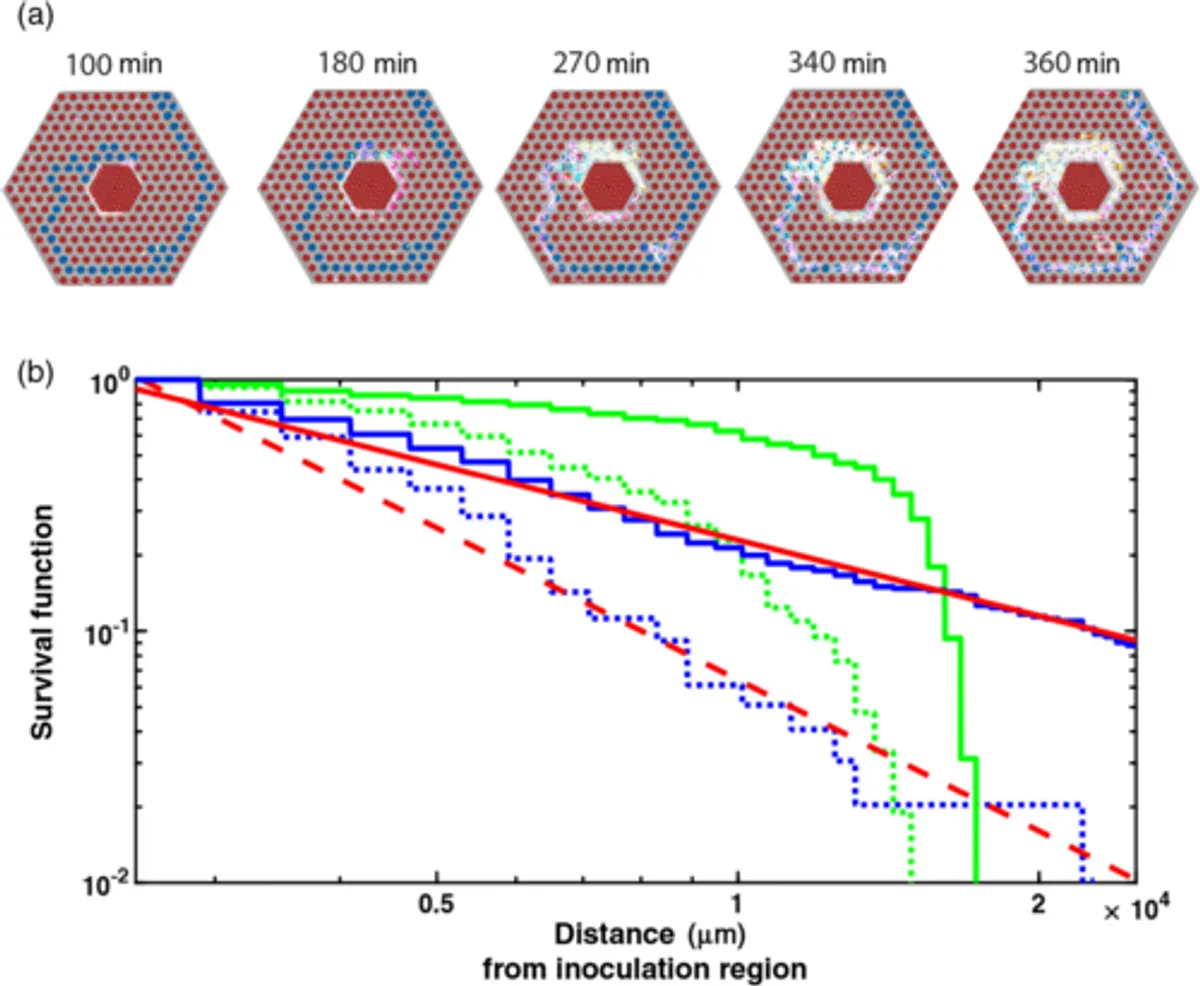
Bacteria which grow not on the featureless agar plates of the microbiology lab but in the real world must navigate topologies which are nontrivially complex, such as mazes or fractals. We show that chemosensitive motile E. coli can efficiently explore nontrivial mazes in times much shorter than a no-memory (Markovian) walk would predict, and can collectively escape from a fractal topology. The strategies used by the bacteria include individual power-law probability distribution function exploration, the launching of chemotactic collective waves with preferential branching at maze nodes and defeating of fractal pumping, and bet hedging in case the more risky attempts to find food fail.
Citation
Phan, Trung V., Ryan Morris, Matthew E. Black, Tuan K. Do, Ke-Chih Lin, Krisztina Nagy, James C. Sturm, Julia Bos, and Robert H. Austin. “Bacterial route finding and collective escape in mazes and fractals.” Physical Review X 10, no. 3 (2020): 031017.