Capillary interactions drive the self-organization of bacterial colonies
We showed that capillary forces, arising due to the wetting of individual bacteria, organize and determine the structure of populations of gliding bacteria.
Abstract
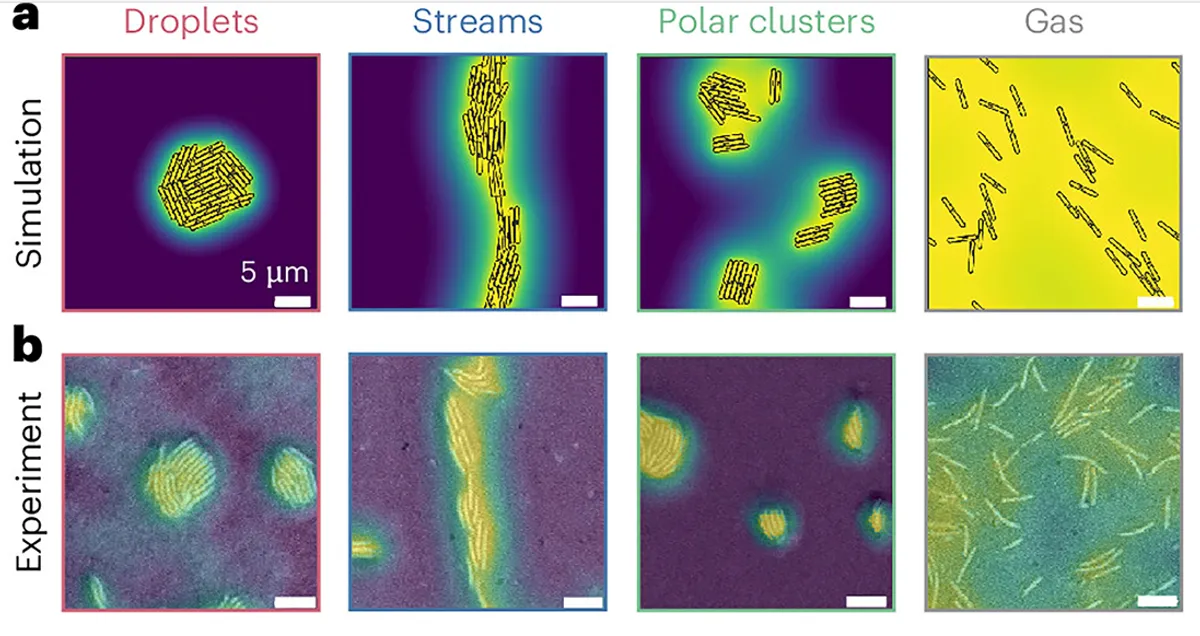
Many bacteria inhabit thin water layers on solid surfaces. These thin films occur both naturally—in soils, on hosts and on textiles—and in the laboratory on agar hydrogels. In these environments, cells experience capillary forces, but it is unclear how these forces shape bacterial collective behaviour. Here we show that the water menisci formed around bacteria lead to capillary attraction between cells while still allowing them to slide past one another. We develop an experimental apparatus that allows us to control bacterial collective behaviour by varying the strength and range of capillary forces. Combining three-dimensional imaging and cell tracking with agent-based modelling, we demonstrate that capillary attraction organizes rod-shaped bacteria into densely packed nematic groups and influences their collective dynamics and morphologies. Our results suggest that capillary forces may be a ubiquitous physical ingredient in shaping microbial communities in partially hydrated environments.
Citation
Black, M.E., Fei, C., Alert, R. et al. Capillary interactions drive the self-organization of bacterial colonies. Nat. Phys. 21, 1444–1450 (2025). https://doi.org/10.1038/s41567-025-02965-y
Highlights
See what others have to say! This work has been highlighted in Nature Chemical Engineering and Current Biology.