3D Agent-Based Modeling without Chemical Signaling Recreates Collective Behaviors seen in Myxococcus xanthus Colonies
We created a simulation framework to study how active matter physics alone can explain various facets of myxobacterial collective behavior.
Abstract
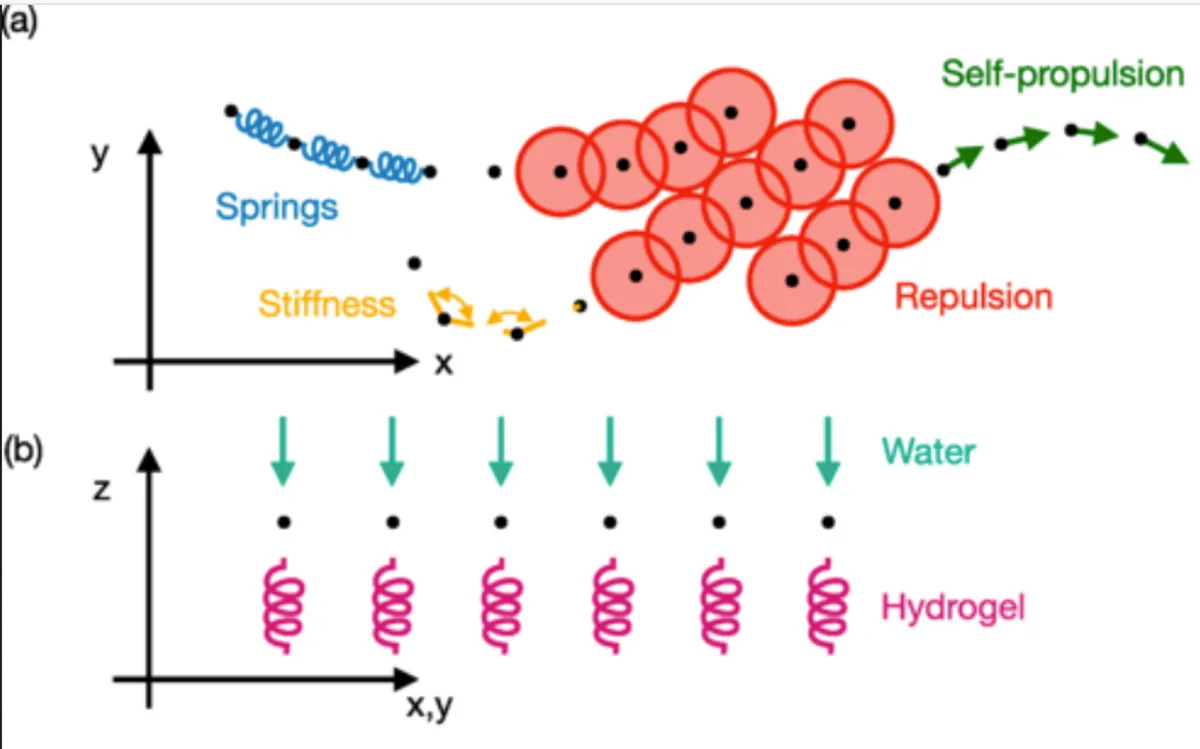
Myxococcus xanthus is a soil-dwelling bacterium that lives in dense populations of millions of cells and displays an array of collective behaviors and macroscopic patterns in response to environmental conditions. The transitions between macroscopic patterns formed by this species are driven by changes in cell motility such as increasing Péclet number via increasing cell speed and reversal period. While cells are capable of passing contact-mediated signals that can trigger reversal events, we set out to study which aspects of M. xanthus collective behavior may be driven by simple individual cell behavior changes in the absence of direct chemical cell signaling. We do this through three-dimensional agent-based simulations with a bead-spring chain model. We find that when tuned to match single-cell properties, this model captures multicellular structures observed at both intermediate and global scales in M. xanthus experiments. Increasing cell speed and reversal period together (as cells do when they starve) maintains a constant overall nematic structure in the population, while significantly increasing the net flow into and out of topological defects, which drives an increased aggregation that leads to fruiting-body formation during starvation.
Citation
Copenhagen, Katherine, Matthew Black, and Joshua W. Shaevitz. “3D Agent-based modeling without chemical signaling recreates collective behaviors seen in Myxococcus xanthus colonies.” bioRxiv (2025): 2025-05.